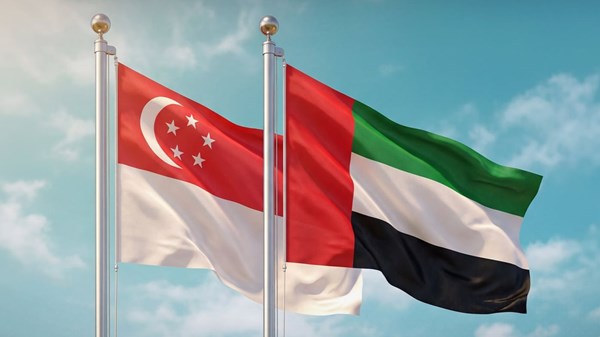
Non-oil trade between the two nations grows by 25.3% as discussions focus on expanding investment, strengthening private sector cooperation and creating new business opportunities.
The United Arab Emirates and Singapore are exploring further opportunities to strengthen their economic partnership, with a renewed focus on bilateral trade, investment cooperation and closer engagement between businesses in both countries.
During an official visit to Singapore, Dr. Thani bin Ahmed Al Zeyoudi, UAE Minister of Foreign Trade, met with Gan Kim Yong, Singapore's Deputy Prime Minister and Minister for Energy, Trade and Industry, and Dr. Tan See Leng, Minister for Energy, Trade and Industry.
The discussions focused on strengthening existing economic relations, identifying opportunities for greater investment cooperation and developing partnerships that support sustainable economic growth.
The meeting was also attended by Dr. Abdulnasser Jamal Al Shaali, UAE Ambassador to Singapore.
Economic relations between the UAE and Singapore have continued to expand, supported by increasing trade activity and investment flows.
Bilateral non-oil trade reached USD 6.54 billion in 2025, compared with USD 5.2 billion in 2024, representing a year-on-year increase of 25.3%.
The figures highlight the continued development of commercial relations between the two countries, with the UAE maintaining its position as Singapore's largest trading partner in the Middle East.
Investment activity has also contributed to the growing economic relationship. Between 2021 and 2025, UAE direct investment in Singapore totalled USD 5.12 billion, reflecting the scale of investment connections between the two markets.
The discussions between officials from both countries centred on identifying new areas of cooperation and strengthening the role of the private sector in bilateral economic relations.
Both sides examined opportunities to encourage businesses and investors to translate potential investment opportunities into practical projects.
The exchange of knowledge and expertise was also identified as an important factor in supporting sustainable economic growth and developing stronger commercial partnerships.
Greater cooperation between the business communities of the UAE and Singapore remains a key focus, particularly in facilitating trade flows, encouraging investment and supporting economic diversification.
Alongside the official discussions, Al Zeyoudi held a series of meetings with representatives of Singapore's private sector, including investors, business leaders and senior representatives of major companies and economic institutions.
These meetings focused on exploring opportunities for mutual investment, identifying potential partnerships and strengthening commercial engagement between businesses operating in both countries.
The discussions also examined how companies and investors could benefit from emerging opportunities in the UAE and Singapore.
Both countries recognise the importance of private sector participation in supporting economic development, creating business connections and strengthening integration between international markets.
Singaporean businesses have established a presence across several sectors of the UAE economy, reflecting the breadth of commercial relations between the two countries.
Approximately 230 Singaporean companies have established operations in the UAE, with activities spanning a range of industries.
Key sectors include real estate, hospitality and tourism, energy, telecommunications, transportation and warehousing.
This business presence demonstrates the role of cross-border investment and commercial partnerships in supporting economic engagement between the UAE and Singapore.
The latest discussions reflect the continued efforts of both countries to develop more diversified and sustainable economic relationships.
With bilateral non-oil trade recording double-digit growth in 2025, the UAE and Singapore are seeking to build on their established economic connections through stronger business engagement and investment cooperation.
The focus on exchanging expertise, encouraging private sector participation and identifying new opportunities is expected to remain central to the development of bilateral relations.
As both economies continue to explore areas of mutual interest, closer cooperation between businesses, investors and economic institutions will play an important role in advancing their trade and investment partnership.
Accepted cards