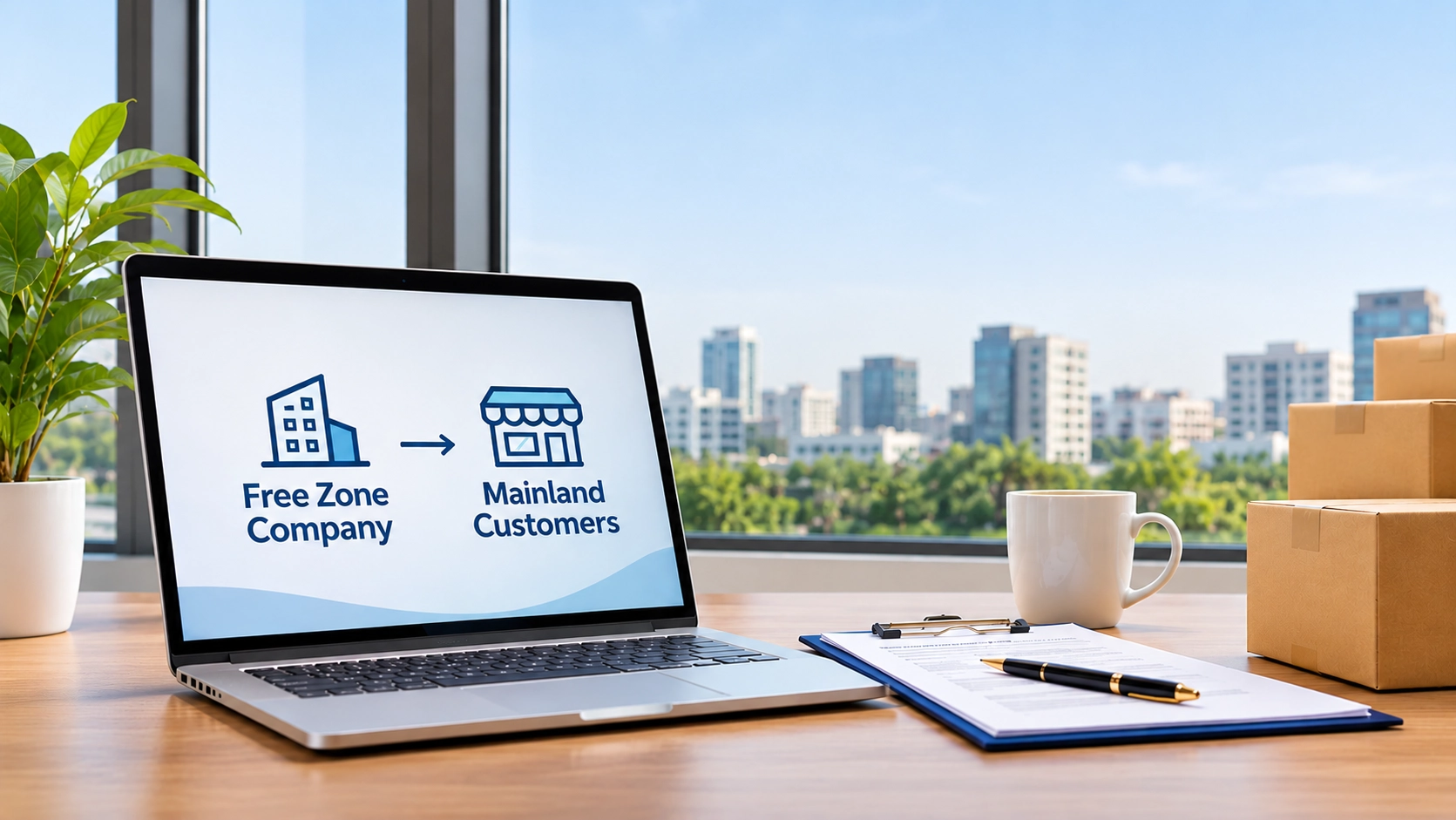
Yes, a UAE free zone company can serve mainland customers through the appropriate licensed arrangements. However, a free zone licence does not automatically permit unrestricted business operations on the UAE mainland.
The rules depend on the business activity, where it takes place and how the company delivers its products or services.
Under the UAE Government's guidance on running a business in a free zone, companies can access the mainland market through regulated arrangements, such as an appropriately licensed mainland distributor or a mainland branch or company. The necessary licences and approvals depend on the activity and jurisdiction.
For companies considering business setup in a UAE free zone, this distinction matters. Serving a mainland business with consultancy services is different from importing products, supplying retailers or fulfilling online orders.
Here is how the requirements differ and what to check before choosing your UAQFTZ licence.
Can a UAE Free Zone Company Provide Services to Mainland Clients?
A UAE free zone company may provide services to mainland customers through a permitted arrangement. The company must first confirm that its licence and operating structure authorize the proposed activity.
UAQFTZ offers service licences for activities such as consultancy and other professional services. Its official service-licence guidance states that activities under these licences are authorized within the free zone. It also specifies that services provided in the UAE market must be carried out through a local agent under its published general licensing conditions.
Example: A consultancy serving a mainland company
Consider a marketing consultancy registered with UAQFTZ that receives a project from a Dubai-based retailer.
The consultancy needs to establish:
- Whether its licence covers the requested marketing services.
- Which local-agent or other mainland authorization arrangements apply.
- Whether work will take place inside the free zone, remotely or at the client's mainland premises.
- Which entity will enter into the contract and issue invoices.
- Whether the activity requires additional professional or sector-specific approval.
Unlike goods trading, ordinary consultancy work does not involve shipping inventory or clearing imported products through customs.
That distinction simplifies the logistics, but it does not remove the need to comply with business-licensing rules.
Before signing a mainland service contract, confirm the permitted arrangement with UAQFTZ and any relevant mainland authority.
Can a Free Zone Company Sell Products to Mainland Customers?
Yes. Free zone companies can supply products to mainland customers through arrangements permitted by the applicable commercial and customs rules.
UAQFTZ's commercial licence allows businesses to import, export, distribute and store goods covered by their approved activities. Its published guidance states that commercial-licence holders can trade within the UAE through mainland distributors.
A product-trading or general-trading licence therefore needs to be matched with a practical distribution and import plan.
Example: Supplying products to mainland retailers
Suppose a UAQFTZ company imports packaged consumer goods and plans to supply retailers in Dubai.
Before starting sales, the company should establish:
- Licensed products: Does its commercial activity cover the products?
- Distribution: Which appropriately licensed mainland distributor or other authorized arrangement will be used?
- Storage: Will the goods remain in the free zone before mainland delivery?
- Import responsibility: Who will handle declarations and customs clearance?
- Product compliance: Do the goods require registration, labelling or additional approvals?
Requirements can vary by product category. Food, cosmetics, chemicals and medical products may be subject to additional sector-specific controls.
A trading licence and a completed customs declaration serve different purposes. The company needs both the appropriate business permissions and a compliant route for moving the goods.
How Do Mainland Distribution, Imports and Customs Work?
Three parts of a product-trading operation need to be considered separately.
Business licensing determines which commercial activities the company is authorized to conduct.
Mainland distribution concerns the permitted commercial arrangement through which the products are supplied to customers.
Customs clearance governs the movement of goods across the applicable customs boundary, including declarations, documentation and duties.
The UAE Government explains that goods moved from a free zone into the mainland market are subject to the applicable customs procedures and duties. Goods held in a free zone for re-export may receive different treatment.
What should an importer confirm?
Before purchasing stock or arranging delivery, identify:
- Where the goods will be stored.
- Which company will act as importer.
- Who will prepare the customs declaration.
- Which distributor or approved arrangement will be used.
- Whether the products require permits or registration.
- Who will handle transport and delivery to the buyer.
For example, a company importing goods into a UAQFTZ warehouse for re-export has a different operating model from one importing the same goods for sale to mainland retailers.
The first model focuses on international trade and re-export. The second also needs a permitted mainland distribution route and applicable customs clearance.
Can UAQFTZ facilities support product trading?
UAQFTZ offers facilities such as offices, warehouses and industrial land to support different business activities.
Warehousing may be useful for companies holding stock before distribution or re-export. However, leasing a warehouse does not independently authorize direct mainland trading.
Confirm the facility type, permitted activity and any required approvals before committing to storage or distribution arrangements.
Can a Free Zone Company Run an E-Commerce Business Serving UAE Customers?
Yes, a company registered in a UAE free zone may operate an e-commerce business, subject to the appropriate licensed activities and applicable mainland-market requirements.
UAQFTZ offers e-commerce activities for eligible online trading models. However, having an online storefront does not remove distribution, customs or product-compliance obligations.
The company's fulfilment model determines which practical arrangements must be examined.
Scenario 1: Products stored in a free zone
An online retailer keeps inventory in a UAQFTZ warehouse and receives orders from mainland UAE customers.
The business must confirm its e-commerce or trading activity, the permitted mainland sales arrangement, customs clearance responsibilities and delivery process.
Scenario 2: Products shipped from overseas
An online seller arranges for a foreign supplier to ship goods to customers in the UAE.
The business needs to determine who is responsible for importing the products, customs clearance and any relevant product approvals. It must also confirm that the proposed sales arrangement is permitted.
Scenario 3: Sales through online marketplaces
A company lists its products on an online marketplace such as Amazon or Noon.
Marketplace access does not automatically establish permission to conduct an otherwise restricted business activity. The seller needs to comply with the platform's requirements and the licensing, customs and product rules applicable to its operating model.
For any e-commerce setup, map the transaction from customer order to final delivery before selecting the licence activity.
Which Free Zone Business Model Suits Your Mainland Customers?
The following comparison shows what different businesses should check before operating.
| Business model | Mainland considerations | What to check | UAQFTZ options |
|---|---|---|---|
| Consultancy or agency | Service permissions, local-agent arrangements and location of work | Activity, authorization, contracts and approvals | Service or consultancy activity; office |
| Product trader | Mainland distribution and customs | Distributor, importer, storage and product approvals | Commercial or trading activity; warehouse |
| Importer/exporter | Re-export versus mainland supply | Customs procedures, goods movement and distribution | Import/export activity; warehouse |
| E-commerce brand | Online sales and fulfilment | Licence, seller arrangement, customs and delivery | E-commerce activity; suitable facilities |
| Manufacturer | Industrial permissions and mainland sales | Facility, product approvals, distributor or agent | Industrial licence; warehouse or industrial land |
For manufacturers, UAQFTZ's industrial-licence guidance states that products sold within the UAE market must be supplied through a local distributor or agent.
A company combining consultancy, product trading and e-commerce should check the requirements for each activity rather than assuming that approval for one covers the others.
Does a Free Zone Company Need a Mainland Licence?
A free zone licence alone does not authorize unrestricted operations on the mainland. However, an additional mainland licence is not necessarily the only possible route to mainland customers.
The UAE Government identifies regulated arrangements, including trading through an appropriately licensed mainland distributor or establishing a mainland branch or company.
The appropriate option depends on the business model, the activity and the emirate in which the activity will take place.
This is particularly important for founders considering a free zone business while expecting most of their customers to be mainland businesses.
Before registering, establish whether the operating model will rely on an agent or distributor, require an additional mainland establishment, or need specific permissions from the relevant authority.
What Should You Check Before Free Zone Company Formation in the UAE?
Choosing a licence begins with knowing how the business will actually operate.
Use the following checklist before registering with UAQFTZ.
- Customer location: Will you sell mainly to mainland businesses, UAE consumers, international customers or a combination?
- Business activity: Are you providing services, trading goods, manufacturing products or operating an online store?
- Operating location: Will work take place inside the free zone, at mainland premises or through another authorized arrangement?
- Mainland permissions: Do you need a local agent, mainland distributor, additional licence or other approval?
- Goods movement: Who will import, store, clear and deliver products?
- Sector requirements: Are the products or professional services subject to additional regulation?
- Facilities: Do you need an office, warehouse or industrial premises?
- Other setup considerations: What visa, banking and tax requirements apply to the proposed structure?
These questions will help UAQFTZ assess the business model and identify the licence activities and facilities to explore.
Frequently Asked Questions
Can a UAE free zone company invoice mainland customers?
A free zone company may invoice mainland customers for transactions conducted under a permitted operating arrangement. However, invoicing and permission to carry out the underlying activity are separate considerations.
Confirm the applicable licensing conditions, contract structure and tax obligations before proceeding.
Can a free zone company sell directly to mainland consumers?
Access to mainland consumers is possible through compliant arrangements. Whether direct selling is permitted depends on the relevant licence, activity, jurisdiction and any additional approvals.
For physical products, distribution, customs and product-compliance requirements must also be considered.
Can a UAE free zone company sell through Amazon or Noon?
A company may be able to sell through online marketplaces using the appropriate e-commerce or trading activity. Marketplace participation does not replace applicable business permissions, customs procedures or product requirements.
Is a free zone suitable if most customers are on the mainland?
It can be, provided the permitted arrangements suit the company's actual operations.
Compare the proposed free zone model with a mainland setup, considering distribution, local-agent requirements, regulatory approvals and the intended location of business activities.
Can a free zone company import and export goods?
Yes. UAQFTZ offers commercial and industrial activities that cover specified importing and exporting operations. However, goods entering the mainland market must meet applicable customs and mainland-trading requirements.
Do free zone companies pay customs duty when selling to the mainland?
Goods entering the UAE mainland from a free zone are generally subject to applicable customs duties and clearance procedures. The actual treatment depends on the goods, customs classification and relevant rules. Confirm the applicable requirements with the competent customs authority.
Business Setup in a UAE Free Zone: Choose the Licence That Fits Your Customers
A UAE free zone company can access mainland customers, but the right structure depends on the activity and the way the business operates.
For service companies, the priority is confirming the permitted service-delivery arrangement. For product traders, it is identifying the appropriate distribution and customs route. For e-commerce brands, it is ensuring the licence and fulfilment model comply with relevant requirements.
UAQFTZ offers more than 1,500 business activity options across its licensing categories, together with offices, warehousing and industrial facilities.
Before choosing a licence, explain your business model: what you sell, where your customers are, how the activity will be conducted and how goods or services will reach the buyer.
Discuss your exact customer and distribution model with UAQFTZ before selecting your activity.